Haydn: Dialogues
Haydn: Dialogues is a multi-season commissioning project that reimagines the traditional string quartet cycle. Over the course of the next ten seasons, concluding in 2032 (Haydn’s 300th birth anniversary), the Cramer Quartet will perform Haydn’s 68 string quartets alongside newly commissioned works by American composers. Each commission is an invitation for a composer to respond to an opus from Haydn’s string quartet oeuvre in the composer’s own musical voice, writing specifically for historical instruments. Haydn: Dialogues is made possible with support by the New York State Council with the support of the Office of the Governor and the New York State Legislature.

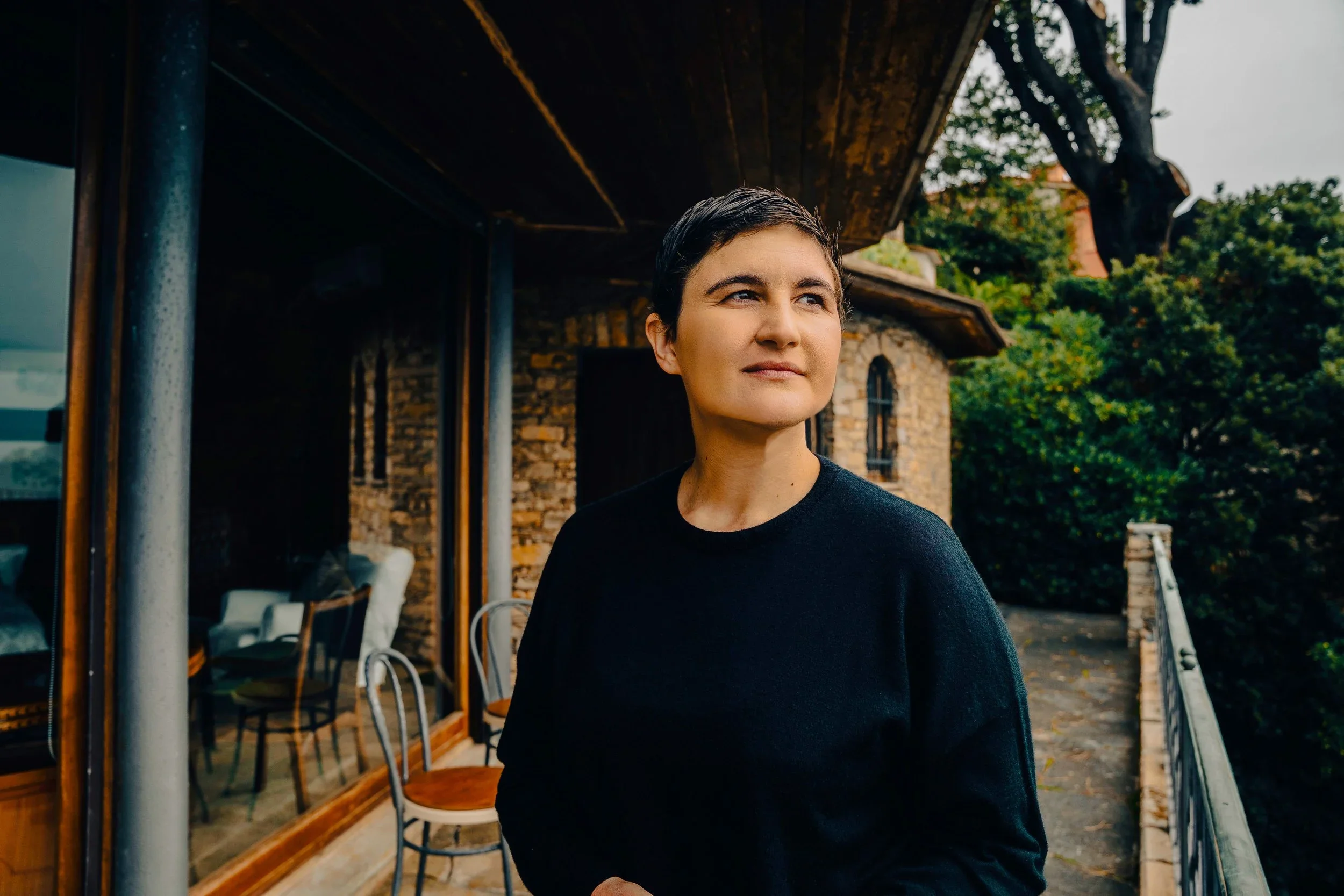
Photo by Laura Banchi, courtesy of The Bogliasco Foundation
Leilehua Lanzilotti
Haydn Op. 77 String Quartets
Leilehua Lanzilotti (b. 1983) is a composer and multimedia artist whose works often explore dramatic expanses of color and timbre, engaging with themes of place, displacement, and layered time.
Lanzilotti was honored to be a 2022 Pulitzer Prize Finalist in Music for with eyes the color of time (string orchestra), which the Pulitzer committee called, “a vibrant composition . . . that distinctly combines experimental string textures and episodes of melting lyricism.” Other prestigious honors Lanzilotti has received include a Creative Capital Award, a Native Arts & Cultures Foundation’s SHIFT – Transformative Change and Indigenous Arts Award, and recognition as a 2025 USA Fellow. Lanzilotti has received additional distinguished fellowships & residencies through The Rockefeller Foundation Bellagio Center, Casa Wabi, the Merwin Conservancy, the McKnight Visiting Composer Residency Program, Copland House, and the MacGeorge Fellowship at the University of Melbourne among others.
As a composer, Lanzilotti’s works have been presented at international festivals such as Ars Electronica (Austria), Sonic Arts Biennial (The Netherlands), Un-Earthed: a festival of listening and environment (UK), Ojai Music Festival (USA), and Thailand International Composition Festival; and in halls such as the Philharmonie de Paris and Tokyo Metropolitan Theatre. In fall 2025 Lanzilotti’s “luminous new piece” (Alex Ross, The New Yorker), of light and stone opened the New York Philharmonic’s season and Gustavo Dudamel’s first concert as the orchestra’s Music & Artistic Director designate. Lanzilotti’s work has also been championed in frequent performances by Roomful of Teeth (USA), Sō Percussion (USA), Extended Music Collective (Belgium), Ensemble Three (Australia), and others worldwide.
As a recording artist, Lanzilotti has played on albums from Björk's Vulnicura Live and Joan Osborne's Love and Hate, to David Lang’s anatomy theater. Lanzilotti also premiered and recorded Dai Fujikura’s Viola Concerto Wayfinder as a soloist with the Nagoya Philharmonic, Keita Matsui, conductor. in manus tuas, Lanzilotti’s solo viola album debut, was featured in The Boston Globe’s Top 10 classical albums of 2019 and Bandcamp’s Best Contemporary Classical Albums of 2019.
As an experimental sound artist, Lanzilotti’s projects include performing with object instruments created by Isamu Noguchi, Toshiko Takaezu, Harry Bertoia, Adam Morford and Maika Garnica; and with Gahlord Dewald as a member of The Yes &. Lanzilotti was part of the inaugural cohort of Wehiwehi, a residency-based gathering of Native Hawaiian artists working at the intersection of indigeneity & contemporary performance supported by the Doris Duke Foundation, and hosted at Shangri La Museum in Honolulu, Hawai’i. Additionally, Lanzilotti is part of the network of musicians and artists in the Wandelweiser collective.
Lanzilotti’s video installation works have been shown in The Noguchi Museum; Cranbrook Art Museum; the Museum of Fine Arts, Houston; Chazen Museum of Art, University of Wisconsin-Madison; the Honolulu Museum of Art; Nicosia Municipal Arts Centre, Cyprus; and Alison Jacques Art Gallery, London, UK.
As a scholar, Lanzilotti’s written publications include contributions to the monograph Toshiko Takaezu: Worlds Within (Yale University Press), and to Tuning Calder’s Clouds edited by Vic Brooks and Jennifer Burris (Calder Foundation and Athénée Press)—the first book to explore the artistic, technological, and political intersections of Alexander Calder’s sculptural Acoustic Ceiling. Lanzilotti’s musical work beyond the accident of time (2019) is included in Walking From Scores (Les presses du réel), a bilingual anthology of text and graphic scores to be used while walking, from Fluxus to the critical works of current artists, through the tradition of experimental music and performance.
A dedicated educator, Dr. Lanzilotti has been on the faculty at the New York University Steinhardt School of Culture, Education, and Human Development; University of Northern Colorado as the Director and founder of the experimental UNCOmmon Ensemble, Co-director of Open Space Festival of New Music, and Assistant Professor of Viola; and various international summer festivals such as the Banff Centre for Arts & Creativity INTERPLAY program. Additionally, Lanzilotti created Shaken Not Stuttered, a free online resource demonstrating extended techniques for strings.
Lanzilotti is a graduate of Oberlin Conservatory of Music (BMus), Yale School of Music (MMus), and Manhattan School of Music (DMA). In addition, Lanzilotti was an orchestral fellow in the Rundfunk-Sinfonieorchester Berlin and New World Symphony, participated in the Lucerne Festival Academy under Pierre Boulez, and was the original violist in the Lucerne Festival Alumni Ensemble. Mentors include Hiroko Primrose, Peter Slowik, Jesse Levine, Martin Bresnick, Wilfried Strehle, Karen Ritscher, and Reiko Füting.
Pronunciation: Leilehua

Photography by Joanna Malecka Photography
Juri Seo
Haydn Op. 54 String Quartets
Juri Seo* (b. 1981.12.31) is a Korean-born American composer and pianist based in Princeton, New Jersey. She seeks to write music that encompasses extreme contrast through compositions that are unified and fluid, yet complex. She merges many of the fascinating aspects of music from the past century—in particular its expanded timbral palette and unorthodox approach to structure—with a deep love of functional tonality, counterpoint, and classical form. With its fast-changing tempi and dynamics, her music explores the serious and the humorous, the lyrical and the violent, the tranquil and the obsessive. She hopes to create music that loves, that makes a positive change in the world—however small—through the people who are willing to listen.
Her composition honors include a Guggenheim Fellowship, a Koussevitzky Commission from the Library of Congress, a Goddard Lieberson Fellowship and the Andrew Imbrie Award from the American Academy of Arts and Letters, the Kate Neal Kinley Memorial Fellowship, the Ilshin Composer Prize, and the Otto Eckstein Fellowship from Tanglewood. She has received commissions from prominent organizations including the Fromm Foundation, the Barlow Endowment, the Folger Shakespeare Library, Goethe Institut, and Tanglewood. She has released three portrait albums: Toy Store with Carrier Records, and Mostly Piano and Respiri with Innova Recordings. She holds a D.M.A. (Dissertation: Jonathan Harvey's String Quartets, 2013) from the University of Illinois at Urbana-Champaign where she studied with Reynold Tharp. She is Associate Professor of Music at Princeton University.
Juri lives in Lawrenceville, just outside of Princeton, with her husband, percussionist Mark Eichenberger and a little mutt named Roman.
*Note on pronunciation: In North America, my name is pronounced [Jew-ri Suh].

Photography by Oscar Moreno
Darian Donovan Thomas
Haydn Op. 76 String Quartets
Composer, multi-instrumentalist, and interdisciplinary artist Darian Donovan Thomas was born in San Antonio, Texas and is currently based in Brooklyn, New York. He is interested in combining genres and mediums into a singular vocabulary that can express ideas about intersectionality (of medium and identity). Necessarily, he is interested in redacting all barriers to entry that have existed at the gates of any genre - this vocabulary of multiplicity will be intersectional, and therefore all-inclusive.
Darian has been commissioned by YOSA (the Youth Orchestras of San Antonio), Bang on a Can’s summer festival Banglewood, percussionists at Bard College Conservatory, Sam Houston State University, among others. His music has been premiered by So Percussion, YOSA, Bang on a Can Banglewood Fellows, SoSI Fellows, and performed in Iceland, Switzerland, Canada, and all around the United States.
Darian received his Bachelors in Music Composition from The University of the Incarnate Word (2016) in San Antonio, Texas. He has since been a New Amsterdam Records Composer Lab Fellow (2018), So Percussion Summer Institute (SoSI) Composer Fellow (2018), Infinite Palette composer performer for Aeon Ritual at MASSMoCA (2019), and a Bang on a can Summer Institute “Banglewood” Composer Fellow (2019). He has studied with Julia Wolfe, David Lang, Michael Gordon, Sarah Kirkland Snider, William Brittelle, Andrea Mazzariello, Troy Peters, amongst others.

Photography by ella joklik
inti figgis-vizueta
30 mengstaße & Haydn Op. 71 String Quartets
NY-based composer inti figgis-vizueta (b.1993) braids a childhood of overlapping immigrant communities and Black-founded Freedom schools—in Chocolate City (DC)—with direct Andean & Irish heritage and a deep connection to the land. “Her music feels sprouted between structures, liberated from certainty and wrought from a language we’d do well to learn” writes The Washington Post. inti's work explores the transformative power of group improvisation and play, working to reconcile historical aesthetics and experimental practices with trans & Indigenous futures. Recent highlights include the Carnegie Hall premiere of her string quartet concerto, Seven Sides of Fire, written for the Attacca Quartet and American Composers Orchestra, conducted by Mei-Ann Chen; performances of Coradh (bending) by the Spoleto Festival, PODIUM Festival, and Oregon Symphony; and the REDCAT premiere of her evening-length show Music for Transitions, created in collaboration with two-time Grammy Award-winning cellist Andrew Yee, praised as “thrilling” and “revolutionary” by I Care If You Listen. Upcoming projects include Animate Earth for Kronos Quartet’s 50th Anniversary, a new Carnegie Hall-commissioned work for Ensemble Connect, continued development of Earths to Come for vocal ensemble Roomful of Teeth, and a new piano concerto for Conrad Tao and the Cincinnati Symphony, conducted by Matthias Pintscher.
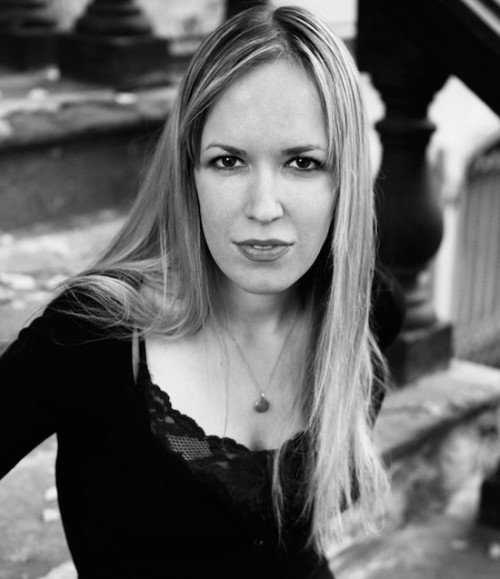
Photography by Nick Ruechel
Alexandra du Bois
String Quartet No. 6 “Strolling in the Ultimate” & Haydn Op. 20 String Quartets
Described as “an intense, luminous American composer” (Mark Swed, Los Angeles Times) and “a painter who knows exactly where her picture will be hung,” (Vivien Schweitzer, New York Times), the music of Alexandra du Bois is often propelled by issues of indifference and inequality throughout the United States and the world.
Alexandra du Bois (Ph.D. Stony Brook University; M.M. The Juilliard School; B.M. Indiana University Jacobs School of Music) is a Manhattan and Vermont based composer and violinist whose musical imagery has continually attracted commissions created to honor or mourn world events both historical and contemporary. Her music has been performed in concert halls across five continents—her travels connecting her tangibly to the countries that inform and inspire her work.
Kronos Quartet founder and first violinist, David Harrington, described the music of du Bois in 2003 as having “found a voice when many people were speechless” who writes music that “attempts to be a conscience in a time of oblivion. She dared to counter abuses of moral authority with an internal, personal sound using the string quartet as a witness, a reminder, that music and creativity are part of a continuing web of responsibility.” (Strings Magazine).
Her commissioned works range from orchestral (symphonic, chamber, and string orchestras) to collaborative (photojournalists, choreographers, playwrights, visual artists, video artists, and filmmakers) to chamber music (solo, duo, trio, quartet, and quintet without conductor) to voice (a cappella choir, double and triple choir, voice and piano, and chamber vocal ensemble).